



What is the best water damage restoration company in Atlanta 2027? Water damage can occur in any Georgia property at any time. Pipe bursts, summer storms, roof and appliance leaks can all cause water to enter a property or business in a short space of time. Quick action is required to minimise damage, mould growth and costs.
Water damage is highly disruptive for property owners, both residential and commercial. It can affect floors, walls, ceilings and possessions. Furthermore, damp can swiftly result in mould growth and odours.
Following water damage, experts carry out water extraction, dry out a property and repair any damage. To access expert water damage restoration services in Atlanta, contact Techvine Home Services. Below are details of the most common reasons for water damage, and an outline of the water damage restoration procedure. We also highlight key points to consider when selecting a water damage restoration provider for 2027.
Selecting the best water damage restoration company in Atlanta 2027 can enable property owners to explore their restoration options.
Need Help With Your Home?
Get in touch with our team today for professional home service assistance.
24/7 Emergency Water Damage Restoration Service – Atlanta
Unfortunately, water damage usually occurs at inopportune times. For example, a pipe may burst during the night and/or a ground floor room may become flooded by a storm over the weekend. Immediate action should be taken in such situations.
- Where safe to do so, turn off the main water valve to try and halt further water flow.
- Turn off electricity to affected areas and avoid using any electrical goods which are in water.
- Relocate possessions, papers and electronic goods to somewhere dry.
- Photograph and film the damage ready for insurance purposes.
- Then, promptly engage expert water damage restoration professionals.
Water and damp need to be removed and the property dried as quickly as possible to reduce repair requirements.
Common Reasons for Water Damage
Atlanta properties are often affected by water due to the local climate, housing and soil.
Heavy Rainfall and Flooding
Atlanta is known for experiencing severe thunderstorms and heavy rain, particularly in the spring and summer months. Further heavy rainfall can also occur in Atlanta due to tropical influences. Rapid heavy rainfall can cause surface water drainage and guttering to become ineffective. Water then flows towards properties and can enter via garage doors, ground floor doors, window wells and low-lying rooms.

Moreover, flash flooding can introduce polluted water containing silt and rubbish. As well as drying, deep and effective cleaning and disinfecting is essential.
Pipe and Plumbing Issues
Pipe and plumbing issues are among the most frequent causes of internal water damage. Old, rusty and high pressure piping and plumbing, together with unexpected temperature drops, can all result in leakage and pipe bursts. Despite Atlanta’s generally mild winter temperatures, brief periods of freezing weather can cause cracks to form in uninsulated or inadequately insulated pipes in attic spaces, crawl spaces and external walls.
Subtle leaks in a wall or beneath a floor can remain undetected for some time. Indicators of leaks include:
- Unjustified rises in water bills
- Discolouration or blistering of walls and/or ceilings
- An odour of damp, despite there being no apparent origin of damp
- Hearing water trickling although all appliances are switched off
As well as plumbing, other appliances including washing machines, dishwashers, fridge water pipes and water heaters can unexpectedly malfunction.
Roof and Ceiling Water Damage
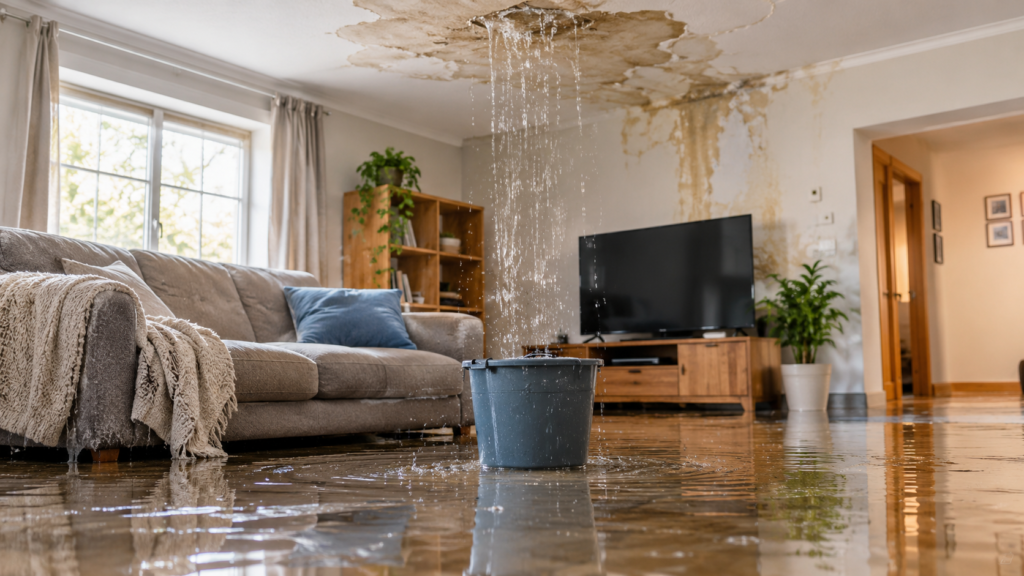
Properties’ roofs can be compromised by storm activity, wind and age. Water can then penetrate and become absorbed by ceiling insulation and drywall. Often by the time a ceiling becomes saggy or stained, there has already been considerable underlying damage.
If you see circular brown spots on a ceiling, witness water dripping from a roof during rain, or identify swollen drywall, then avoid the affected area and seek expert advice. Wet ceilings can collapse and damp insulation retains water for extended periods.
Basement and Crawl Space Water Infiltration
Many Atlanta properties contain either basements or crawl spaces and these can suffer from water ingress. Foundation fissures, insufficiently weatherproofed vents and doors and poor land grading, alongside obstructed drainage, can all permit rainwater entry. Non-functioning sump pumps further compound this issue.
Water in basements and/or crawl spaces can adversely affect possessions together with floor joists, subfloor and insulation. Plus, the presence of water beneath a property elevates internal humidity levels, favouring mould growth and attracting insects.
Mould and Damp
Within Georgia’s hot and humid environment, damp materials will remain so unless effectively dried. Under favourable conditions mould can begin to develop on damp drywall, carpet, wood and insulation within 24 – 48 hours.
- Indicators of mould and damp are:
- An odour suggestive of damp or earth
- Black, green or grey mould on walls and/or ceilings
- Flaking paint and/or wallpaper
- Twisted baseboards and/or flooring
- Condensation or continual damp around windows
Should you believe there is extensive mould growth, do not attempt to interact with or eradicate it. Rather, consult an appropriately qualified expert.
Atlanta’s Soil and Drainage
Predominantly, Atlanta is constructed upon clay-based soils. Clay has a poor drainage capability and so following periods of heavy rainfall, water can accumulate against foundations. This in turn places additional strain upon basement walls and slabs and enhances the likelihood of water penetration. Clay also swells when wet and contracts when dry. This can lead to foundation cracking and hence subsequent water ingress.
Properties situated on sloping land or on hills, along with incorrectly graded gardens can all channel rainwater directly towards a property. Obstructed gutters, brief downspouts and blocked French drains further compound the issue. Ideally, the root cause of water damage should be addressed, alongside water drying.
Efficient Water Extraction Services – Atlanta
Water can rapidly permeate floors, walls, carpets and furnishings. Professionals utilise pumps, wet vacuums and extractors which can remove much greater volumes of water than domestic appliances.
Typically, water damage restoration involves:
- Investigation – Locating the water’s origin, evaluating the extent of damage and determining the water type.
- Extraction – Removing free-flowing water from floors, carpets, basements and crawl spaces.
- Drying – Employing industrial fans and de-humidifiers to dry the property and its contents.
- Moisture investigation – Detecting concealed damp in and beneath walls and floors through the use of moisture gauges and thermal imaging.
- Cleaning and Disinfection – Thoroughly cleansing and disinfecting impacted areas and goods.
- Repair – Replacing compromised drywall, flooring, insulation and paint so that a property can be restored to its former state.
Effective drying is key in avoiding mould development and structural damage.
Residential and Commercial Water Damage Restoration – Atlanta
Water damage can occur in residential, apartment, office, retail, restaurant and other business properties.
Within homes, water damage restoration aims to re-establish a property as a secure, dry and pleasant environment having dealt with leaks, roofing issues, appliance malfunctions and/or flooding.
For businesses, water damage can impact multiple rooms and levels together with common services. Such damage can disrupt business functioning. Quick action enables businesses to better safeguard goods, stock and paperwork and to resume usual business activity for both staff and customers.
The appropriate strategy for water damage restoration will depend on the property type, the water’s origin, the impacted materials and the duration that water has been present.
Mould Repair & Prevention
Even after removing water, mould can still form if there continues to be moisture within walls, insulation and/or subfloor.
Typical mould repair services include:
1. Identifying and repairing the cause of the moisture
2. Sectioning off the effected area
3. Disposing of items that are too badly affected for cleaning
4. Cleaning and then disinfecting surrounding areas
5. Dry the area and verify that correct levels of dryness have been achieved.
Preventatively, repair leaks promptly, maintain gutters and ensure that downpipes do not spray onto your home. In addition, utilise a de-humidifier in humid parts of the home and ensure that the indoor environment does not become too moist.
Costs and Insurance Advice – Water Damage Repair
Costs will differ. For example, a leaking appliance will almost certainly be cheaper to repair than a basement or roof space which has both flooded and subsequently damaged insulation and/or ceiling. Cost will generally depend on:
- Extent of damage
- Quantity and nature of water
- Type of material (hardwood, carpet, drywall etc)
- Required drying tools and timescale
- Whether mould repair is necessary
- The degree of repair and rebuilding that is necessary
Before large scale repair is undertaken, obtain detailed information regarding the planned procedures.
Household insurance
Insurance policies differ. Typically, accidental and sudden water damage (such as from a leaking pipe) is dealt with separately to ongoing or external water ingress (which may require additional ‘flood’ insurance). If you face water damage, you should:
- Inform your insurance company promptly
- Wherever possible, photograph and film the damage
- Retain evidence of expenditure incurred on both emergency repairs and on alternative accommodation.
- Investigate your insurance policy and its terms and conditions to establish what is and is not covered.
- Retain copies of quotations, bills and repair information.
Whilst your repair business will frequently be able to supply information, along with hygrometers and photographic material, to aid your insurance claim, your insurer will still decide if your claim is approved.
Why choose Techvine Home Services?
Water damage is never fun and can occur in both your house and/or office. Whether it has been caused by a leaking pipe, water ingress or bad weather; selecting the best water damage repair company in Atlanta 2027 can help you to successfully address water damage. Techvine Home Services can guide you on how to do this.
Consider these factors:
- Speed – a quick reaction time will help to reduce and avoid further issues.
- Full range of services – Ideally, the company will have the skills and resources to extract water, dry, clean and repair.
- Correct tools – Companies should have access to humidity detectors, water extraction gear, fans and dehumidifiers.
- Good communication – The company should be able to outline and detail how they will repair the issue.
- Appropriate experience – Enquire about their experience with properties similar to yours and also the nature of the water damage.
Need Help With Your Home?
Get in touch with our team today for professional home service assistance.
Early contact with our business enables us to advise you on the steps that need to be taken and to recommend an appropriate repair service for your property.